

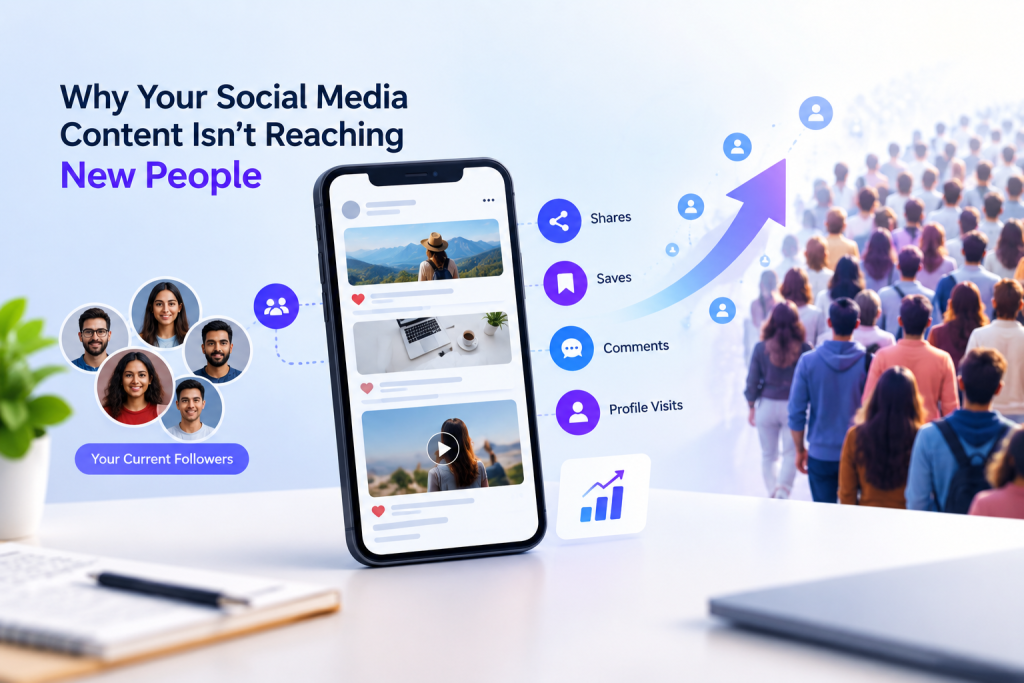
You post consistently. Your content looks good. You use relevant hashtags, write thoughtful captions, and occasionally create a Reel that you genuinely expect to perform well. Yet the same people keep seeing your posts. Your follower count barely changes, non-follower reach stays low, and it starts to feel as though the platform is showing your content to the same small audience over and over again.
This is a common problem across Instagram, TikTok, Facebook, YouTube, and other social platforms. The issue isn’t necessarily that your content is bad. More often, your content isn’t generating enough of the signals that help platforms understand who else should see it.
Your Content May Be Designed for Followers, Not New Viewers
One of the biggest mistakes creators make is creating content for people who already know them. Existing followers understand your personality, brand, products, and previous content. A new viewer doesn’t have that context.
Make individual posts understandable without requiring someone to read your previous posts. Instead of opening with “Here’s another tip from our series,” explain the problem immediately: “If your Instagram Reels aren’t getting views, check these three things first.” The second approach gives an unfamiliar viewer an immediate reason to pay attention.
You’re Getting Engagement, But Not the Right Kind
Not all engagement tells you the same thing. A quick like is easy. A share, save, comment, profile visit, or completed video requires a stronger reason to act.
Content that people genuinely want to send to someone else has a natural path into new networks. For a deeper look at the psychology behind this behavior, read why some social media posts get shared more than others.
Your First Few Seconds Aren’t Holding Attention
If people immediately swipe away from a Reel or abandon a video, the platform receives little evidence that the content deserves broader distribution. Your opening doesn’t need to be sensational; it needs to be clear.
- Ask a question your audience already wants answered.
- State a specific problem.
- Promise a useful outcome.
- Show the result before explaining how you got there.
Your Content Is Too Broad
Trying to appeal to everyone can make content less relevant. “5 Social Media Tips Everyone Should Know” is much less specific than “5 Instagram Content Mistakes Small Business Accounts Make.” Specificity helps people recognize themselves in your content.
A narrower topic does not necessarily mean a smaller opportunity. It can make the content more meaningful to the people most likely to watch, save, share, and follow.
You’re Posting Consistently; but Repeating the Same Format
Consistency matters, but consistency shouldn’t mean producing essentially the same post every day. Test different formats around the same core subject: a Reel for a quick explanation, a carousel for a framework, a Story for a poll, and a longer video for a detailed walkthrough.
This gives you useful data. If carousels consistently generate saves while Reels generate more non-follower reach, each format can have a different job.
You’re Ignoring Shares and Saves
Likes can tell you that people noticed your content. Shares and saves can tell you that they found enough value to do something with it.
Review the journey from reach to likes, comments, saves, shares, profile visits, and follows. A post with fewer views but substantially more shares and profile visits may tell you more about your growth strategy than a post that simply collected a large number of likes.
Your Content Doesn’t Give People a Reason to Share It
Before publishing, ask: “Who would someone send this to?” If you can’t answer that, the post may not have a strong sharing trigger.
- Useful: the viewer knows someone else could benefit from it.
- Relatable: it describes an experience people recognize.
- Entertaining: the viewer wants another person to experience the same reaction.
- Identity-driven: sharing helps someone express something about themselves or their community.
Your Profile May Be Losing New Visitors
Sometimes the content is reaching new people—but the profile isn’t converting them into followers. Check your profile from the perspective of someone who has never seen it before. Can they immediately understand who you are, what your account is about, who the content is for, and what they will get by following?
Your bio, profile image, pinned content, recent posts, and overall consistency should communicate the same basic proposition. Discovery and conversion are separate problems.
You’re Chasing Trends That Don’t Fit Your Audience
Trending audio, memes, formats, and topics can increase visibility, but only when they make sense for your content. A trend should be the delivery mechanism, not the entire idea. Adapt it to your niche instead of forcing your message into whatever is currently popular.
Your Posting Time May Be Working Against You
Timing is not a magic solution, but it can influence initial activity. Instead of relying entirely on generic “best time to post” charts, check your own analytics for audience activity, stronger days, and the posting windows that produce more shares or profile visits.
Your own audience data is more useful than a universal posting schedule because behavior varies by geography, age, industry, and platform.
You’re Measuring Followers Instead of Discovery
Follower growth is important, but it shouldn’t be the only number you watch. If your objective is reaching new people, monitor non-follower reach.
- What percentage of my reach comes from people who don’t follow me?
- Which posts attract the most non-followers?
- Which formats generate the most profile visits?
- Which posts turn new visitors into followers?
- What percentage of viewers watch the content to completion?
A Simple 30-Day Reach Reset
Week 1 — Audit: Review your last 20–30 posts and record reach, non-follower reach, likes, comments, saves, shares, profile visits, and follows.
Week 2 — Improve hooks: Rewrite opening lines and first frames so the topic is immediately understandable to someone unfamiliar with your account.
Week 3 — Create for shares: Publish content that solves specific problems, answers common questions, or gives viewers something they would naturally send to another person.
Week 4 — Review the data: Compare the new posts with your previous baseline, focusing on non-follower reach, share rate, save rate, retention, profile visits, and follower conversion.
What About Using Growth Services?
Organic content should remain the foundation of your strategy. Some creators and brands also experiment with external growth services as part of a broader distribution strategy.
For readers researching that option, SoldOutX’s Instagram growth services cover several forms of Instagram engagement and audience growth.
If the specific objective is increasing the number of shares on a post or Reel, Instagram share services are another resource to evaluate.
Third-party services should not replace useful content, audience research, or organic community building. A stronger metric is only valuable when it supports a broader strategy and is evaluated alongside meaningful audience behavior.
The Real Problem Usually Isn’t “The Algorithm”
When content stops reaching new people, blaming the algorithm doesn’t give you much to work with. A better approach is to diagnose the complete journey: impression → attention → watch/read → engagement → share/save → profile visit → follow.
If people aren’t stopping, improve the hook. If they’re watching but not engaging, improve value or relevance. If they’re engaging but not sharing, make the content more useful or relatable. If they’re visiting but not following, improve the profile.
Final Takeaway
Your social media content doesn’t necessarily need to become more frequent, more polished, or more complicated to reach new people. It needs to give unfamiliar viewers a reason to stop, understand, care, and take action.
Focus on content that is immediately understandable, specific to a real audience, useful enough to save, relatable enough to share, and strong enough to hold attention. Then use your analytics to identify which ideas actually move beyond your existing followers.
For another practical resource on creating content people naturally want to pass along, see this guide to making shareable content.
Frequently Asked Questions
Why is my social media content not reaching anyone?
Low reach can result from weak early retention, limited engagement, poor audience relevance, repetitive formats, or content that doesn’t generate enough shares and saves.
How can I reach people who don’t follow me?
Create content that works without previous knowledge of your account, use discovery-friendly formats, and focus on topics people are likely to share or save.
Why are my posts only reaching my followers?
Your content may not be generating enough signals for wider distribution, or it may depend too heavily on existing audience context. Strong hooks and shareable topics can help.
Do hashtags still help social media reach?
Hashtags can help categorize content, but they are not a guaranteed reach strategy. Relevance, viewer behavior, retention, and engagement also matter.
Does posting every day increase reach?
Not automatically. Consistent publishing can help, but the audience response to the content matters more than simply increasing the number of posts.
What type of content reaches the most new people?
There is no universal winner. Tutorials, relatable posts, visual explainers, useful short-form videos, and highly shareable content can all reach non-followers when they fit the platform and audience.
How long does it take to improve social media reach?
There is no fixed timeframe. Test a new approach for several weeks, compare it with your previous baseline, and look for consistent patterns rather than judging one or two posts.
