

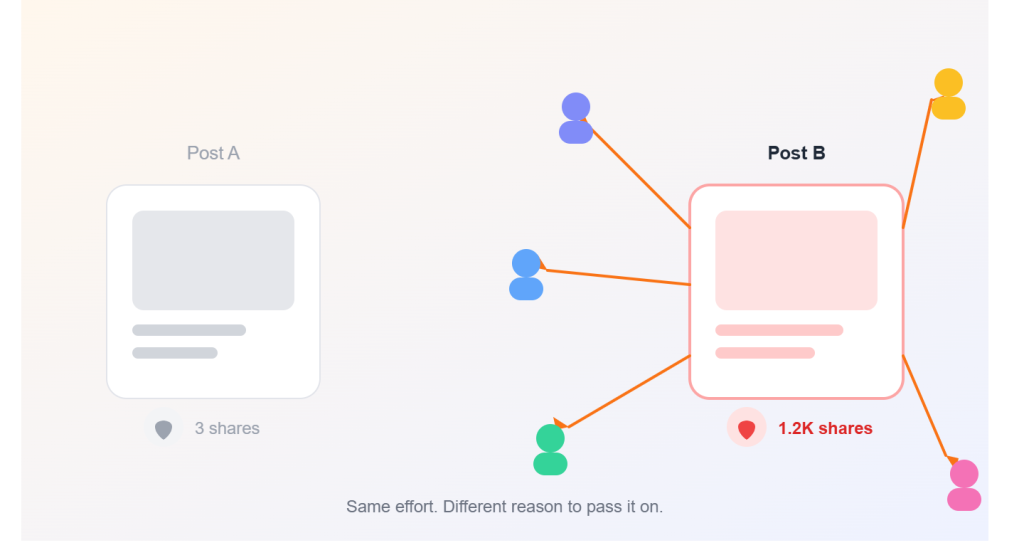
Two accounts post almost identical content. Same niche, same effort, same posting time. One gets buried at 40 likes and disappears. The other gets passed around in DMs, lands on the Explore page, and picks up thousands of new eyes overnight.
The difference usually isn’t luck, and it isn’t really about quality in the way most people assume. It comes down to a handful of specific factors that make a post easy, and worth it, for someone to share.
Shares Are a Different Kind of Signal Than Likes
A like costs almost nothing. A tap, a half-second of attention, done. A share is a different decision entirely. When someone sends your post to a friend or reposts it to their Story, they’re putting their own reputation behind it. That’s a small social risk, and people don’t take it lightly.
This is exactly why platforms weight shares so heavily in their algorithms. A share tells the system something a like never can: that a piece of content was valuable enough for one person to vouch for it to someone else. Posts that clear that bar get pushed to far more people than posts that only rack up passive approval.
What Actually Makes People Hit Share
1. It Says Something They Already Believe, Better Than They Could
Highly shared content usually articulates a feeling, opinion, or joke the viewer already had but hadn’t put into words. Sharing it becomes a form of self-expression, “this is exactly what I think”, which is a much stronger motivator than simple entertainment value.
2. It’s Useful Enough to Reference Later
Practical, save-and-share-worthy content, checklists, comparisons, step-by-step guides, gives people a reason to send it to someone specific who needs that exact piece of information. This is different from content that’s just enjoyable in the moment; usefulness has staying power that pure entertainment doesn’t.
3. It Triggers a Strong, Specific Emotion
Content that makes people laugh out loud, feel genuinely surprised, or hits an emotional nerve travels faster than content that’s simply “nice.” Neutral, safe content rarely gets shared because there’s no emotional spike prompting the “I need to send this to someone” reaction.
4. It’s Tied to an Identity or Community
Posts that speak directly to a specific group, a profession, a fandom, a shared experience, get shared within that community because sharing signals belonging. “Only people who get this will get this” content performs disproportionately well because the share itself becomes a badge of identity.
5. It Arrives With Early Momentum
Posts that pick up fast engagement in the first hour are far more likely to keep climbing, because platforms use that early window to decide how far to push content beyond the existing audience. A post that starts strong gets shown to more people, which creates more opportunities to be shared, which pushes it further, a compounding loop that’s hard to enter late.
Building the Conditions for Shareability
You can’t force a post to go viral, but you can stack the odds. Two engagement signals matter more than most creators realize when it comes to giving a post the early push it needs to enter that compounding loop:
A credible, active-looking account. People are more willing to share content from a profile that already looks established and trustworthy, a stalled or thin-looking account quietly caps how far even great content can travel. Building that baseline with a reliable Instagram followers service gives new and growing accounts the social proof needed for their content to be taken seriously enough to pass along in the first place.
Strong signals in that critical early window. Since platforms lean heavily on how a post performs in its first hour or two, giving a strong piece of content an initial boost through an Instagram likes service can help it clear that early threshold faster, increasing the odds it gets pushed to a wider audience where organic shares can actually take over.
If you want to go deeper on the engagement metric most creators overlook entirely, it’s worth reading why Instagram saves are the most underrated engagement metric, saves and shares work together as the two clearest signals that content has lasting, sharable value, not just momentary appeal.
Final Thoughts
Shareability isn’t random. It’s the product of content that says something people already feel, gives them a concrete reason to send it, and gets enough early traction to be seen by people who’ll pass it along. Fix those three things, and “why didn’t this get shared” stops being a mystery.
FAQs
Why do some low-effort posts get shared more than polished ones?
Shareability depends on emotional or practical value, not production quality. A rough post that says something people relate to instantly will often outshare a highly polished one that doesn’t trigger any specific reaction.
Do shares matter more than likes for reach?
In most current algorithm models, yes. Shares represent a stronger, more costly form of endorsement, so platforms treat them as a more reliable quality signal than likes.
How long does a post have to earn shares before the algorithm stops pushing it?
Most of the critical window happens within the first few hours after posting. Strong early engagement determines how widely a post gets distributed before it can accumulate organic shares.
Can boosting engagement actually increase organic shares?
Yes, indirectly. A stronger early engagement signal increases how many people see the post in the first place, which increases the raw number of people who might choose to share it.
Is there a content format that consistently gets shared more?
Reference-style and identity-driven content, guides people want to send to someone specific, or posts that resonate strongly with a niche community, tend to outperform generic entertainment content in share rate.
