

One week the Reels are pulling in thousands of views, the next they’re stuck in the low hundreds. Nothing obvious has changed: same posting schedule, same niche, same effort. It’s one of the most common complaints among Instagram creators, and it tends to set off a flurry of theories about shadowbans, algorithm changes and secret penalties.
Sudden drops usually have an explanation, but finding it means checking things in the right order. Some causes are visible in a few taps, others take a little detective work. This diagnostic starts with the simplest checks and works toward the deeper ones, then lays out a two-week plan for rebuilding reach.
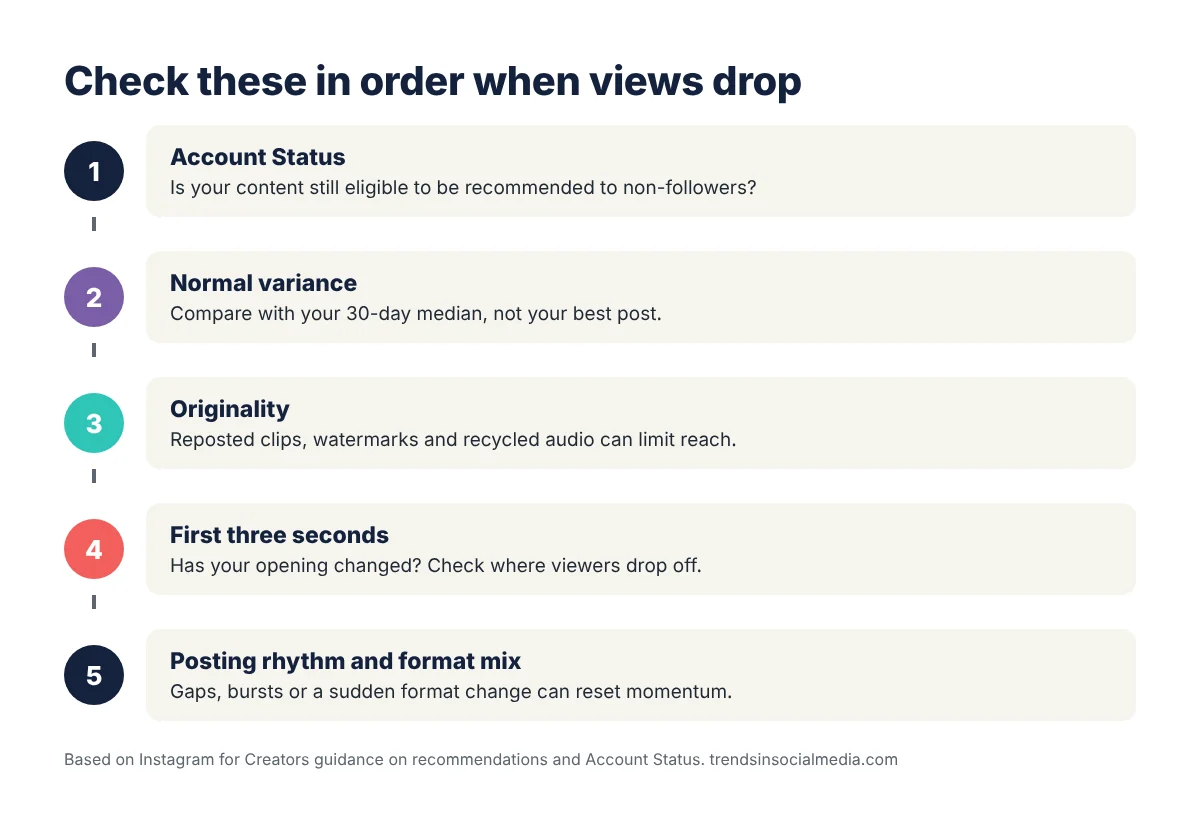
Step One: Check Account Status
Before anything else, open Account Status in Instagram’s settings. This is where Instagram shows whether content has been removed and whether an account’s posts may currently be ineligible to be recommended to non-followers (Instagram Help Center). If a post has been flagged under the platform’s Recommendation Guidelines, reach from Explore, Reels and suggested posts can fall sharply, even though followers can still see the content.
If something has been flagged, Account Status usually explains which post is involved and offers a way to request a review. Removing the post or waiting for the review to finish often restores normal reach. If Account Status is clear, the drop is almost certainly about content or audience rather than a penalty, which is useful to know in itself.
Step Two: Make Sure You’re Comparing Like With Like
Sometimes the drop isn’t real. In November 2024 Meta replaced plays and impressions with a single Views metric across its apps, and changed how repeat views are counted (Meta for Creators). Anyone comparing current numbers against older posts measured under the previous system may see an apparent decline that is really a change in measurement.
It also helps to look at the right comparison. One viral Reel can make every post after it look like a failure, even if those posts are performing normally. Comparing recent posts against the account’s median views over the last 30 days gives a much fairer picture than comparing against a single outlier.
Step Three: Look at Where Views Come From
Insights break down views by follower and non-follower audiences. If follower views are steady but non-follower views have fallen, the content is no longer travelling beyond the existing audience. If both have fallen, something more fundamental has changed, such as topic, quality or posting rhythm. That distinction narrows the search considerably, and our guide on why your content isn’t reaching new people covers the non-follower side in detail.
Step Four: Review Originality and Quality
Instagram has said it prioritises original content in recommendations and has warned that reposted material, or content visibly recycled from other apps, is less likely to be recommended (Instagram Help Center). Accounts that recently started reposting trending clips, using watermarked videos from other platforms or uploading lower-resolution footage often see non-follower views fall as a result. Returning to original, well-produced content is usually the fix.
Quality also includes how quickly a Reel earns attention. Instagram’s ranking for Reels leans heavily on whether people watch to the end, share the video or engage with it (Instagram Ranking Explained). Reels with slow openings, long intros or unclear payoffs tend to lose viewers early, which in turn limits how widely they’re tested. There is a helpful breakdown of why Reels stall at low view counts for anyone whose videos keep plateauing at the same number.
Step Five: Consider Audience and Timing
Audiences shift. Seasonal topics fade, holidays change how much time people spend on the app, and interest in a trend can collapse almost overnight. A creator whose Reels rode a particular trend may see views fall as soon as interest moves on. Checking whether the drop lines up with a change in topic, a seasonal pattern or the end of a trend often explains what the numbers alone can’t. The account’s own rhythm matters too: a long gap between posts, a sudden burst of uploads or an abrupt switch from Reels to static posts can all reset momentum. For a broader view of how ranking works across Feed, Stories and Reels, see how the Instagram algorithm works.
A 14-Day Recovery Plan
Once the likely cause is clear, a short, focused plan helps rebuild momentum. In the first week, the priority is getting back to what worked: reviewing the account’s best Reels from the past few months, identifying what they had in common and producing new content in that style, with strong openings and clear payoffs. Trial reels are useful here, because they let creators test hooks on non-followers without affecting their main feed.
In the second week, the focus shifts to distribution. That means posting consistently, sharing new Reels to Stories, replying to comments quickly and collaborating with accounts in the same niche to reach fresh viewers. Some creators also bring in outside support at this stage, either through an Instagram marketing agency or through influencer growth services that help connect content with the right audience. Whatever the approach, the goal is real viewers who watch and share, because those signals are what bring Instagram’s recommendations back.
The Takeaway
When Instagram views drop suddenly, start with Account Status to rule out recommendation restrictions, then make sure the comparison is fair given the 2024 switch to Views. From there, check whether the fall is coming from followers or non-followers, review originality and quality, and consider whether audience interest or timing has shifted. A focused two weeks of proven content, testing and active distribution is usually enough to see reach recover, and the lessons learned make the next drop easier to diagnose.
