

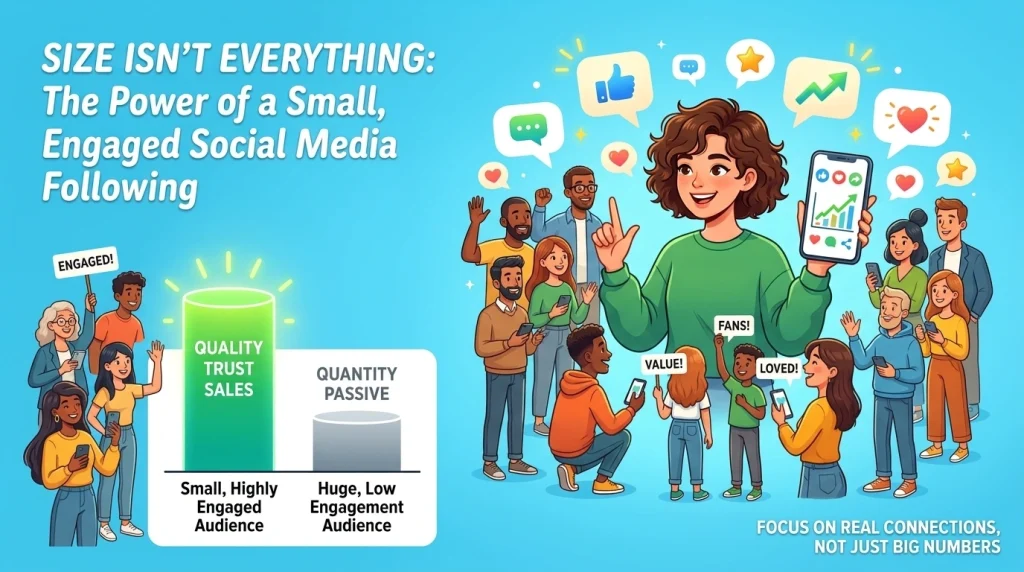
For years, growing on social media meant chasing one number: followers. More followers meant more reach, more credibility, more opportunity. That idea is starting to crack. Brands, platform algorithms, and audiences themselves are shifting toward a different measure of success, engagement over headline follower counts.
If you’re sitting at a few thousand followers and wondering whether you’re “big enough” to matter, the short answer is: you already do. A tightly connected audience of 3,000 people who comment, save, and act on your recommendations is worth more than 300,000 followers who scroll past everything you post. Whether that audience grows organically or gets a boost on your strongest posts from something like Instagram likes to keep the algorithm’s attention, the real asset was never the number on your profile, it’s the people actually paying attention to it.
This isn’t just a feel-good take for creators who haven’t hit six figures yet. It’s backed by how engagement, trust, and buying decisions actually work, and it applies whether you’re building a personal brand, running a small business account, or managing social for a client who keeps asking why a competitor’s smaller page outperforms theirs.
What Counts as a “Small” Audience in 2026?
Size is relative, but most creator marketing now works off a few rough tiers:
- Nano accounts: roughly 1,000–10,000 followers
- Micro accounts: roughly 10,000–50,000 followers
- Mid-tier accounts: roughly 50,000–500,000 followers
- Macro and mega accounts: 500,000 followers and up, often celebrities or major public figures
Most active creators fall into the nano and micro range, not the six- and seven-figure accounts that dominate influencer marketing headlines. If that’s where your account sits, you’re not behind, you’re in the segment brands are actively trying to reach right now. These tiers were originally mapped for Instagram, but the same pattern holds on TikTok, YouTube, and Facebook: smaller, focused audiences consistently out-interact larger, generic ones, even though the exact follower thresholds shift a little by platform.
The Engagement Rate Advantage
Here’s the part most people miss: engagement rate, the share of your audience that actually likes, comments, saves, or shares, tends to drop as follower count climbs. A creator with 5,000 followers pulling in genuine comments on every post is, statistically, outperforming an account with ten times the audience and a flatline comment section.
The reason is simple. Smaller audiences are usually built one relevant follow at a time, through shared interests, niche hashtags, or word of mouth, rather than a broad, passive following that never converts. Platforms tend to reward that kind of fast, real interaction by showing your content to more people, not fewer, which is exactly why a small, active account can keep growing on its own momentum.
It’s also why brands increasingly favor pitches from creators with tight, responsive communities over accounts chasing reach alone. This breakdown of how smaller creators pitch brands walks through how nano and micro accounts turn a modest following into real partnerships. And raw view counts don’t tell the full story either, it’s worth understanding how Instagram actually counts views on Reels before assuming a bigger number always means a bigger win.
Metrics That Matter More Than Follower Count
Engagement rate is the headline number, but it’s not the only one worth tracking once you stop obsessing over follower count. A few others tell you more about whether your small audience is actually working for you:
- Saves and shares. These are stronger intent signals than a like, someone saving your post plans to come back to it, and someone sharing it is vouching for you to their own audience.
- Comment quality, not just comment count. Ten comments asking real questions or tagging friends beats fifty generic comments.
- DMs and story replies. These rarely show up in public analytics, but they’re often where the real relationship-building, and the real sales, happen.
- Link clicks and conversion rate. If your bio link, product tag, or swipe-up sends people somewhere, track what percentage actually click and buy. A small audience with a 4% click-through rate is outperforming a huge one converting at 0.2%, even if the raw numbers look smaller.
None of these metrics need a massive audience to be meaningful. In fact, they’re usually easier to read clearly on a smaller account, where you’re not drowning in noise.
Why Brands and Algorithms Reward Authenticity Over Scale
Audiences trust people, not platforms. Recommendations from someone who feels like a peer consistently land better than content from a faceless, oversized account. That’s the entire logic behind the shift toward smaller creators: a focused audience of a few thousand people who share one specific interest, sustainable fashion, home cooking, gaming, a local business niche — converts at a rate a generic mega-account can’t touch.
For brands, that translates directly into return on investment. A small, on-topic audience is cheaper to reach, easier to measure, and far more likely to act on a recommendation than a large, disengaged one. That’s why niche accounts increasingly get picked for collaborations over accounts with ten times the reach and none of the relevance.
It’s Not Just Influencer Deals — Small Audiences Work for Businesses Too
This isn’t only a creator-economy story. Local businesses, service providers, and small e-commerce brands see the exact same pattern. A boutique with 2,000 local followers who actually visit the store will usually outperform a generic lifestyle page with 50,000 followers scattered around the world.
A few examples of what a small, engaged audience actually does for a business account:
- A local restaurant’s 1,500 followers who are mostly nearby residents and repeat customers drive more foot traffic than a broad regional page with ten times the following.
- A service business, a salon, a tutor, a contractor, often gets more booked appointments from 800 followers who trust their work than from a large, unfocused following that never converts.
- A niche online store selling one specific product category converts better with a tightly matched small audience than with a broad “general lifestyle” following that isn’t actually shopping for what it sells.
The lesson is the same whether you’re a creator or a business: relevance beats reach. A social media audience only has value once it acts, visits, books, buys, or refers someone else. Size alone never guarantees any of that.
Common Mistakes That Waste a Small Audience’s Potential
Having a small following isn’t the problem. What actually holds accounts back is how that audience gets treated. A few patterns worth avoiding:
- Chasing everyone instead of your niche. Trying to appeal broadly dilutes the exact focus that made your small audience engaged in the first place.
- Posting inconsistently. A small, attentive audience notices gaps. Algorithms notice them even more.
- Ignoring comments and DMs. This is the single biggest advantage a small account has over a huge one, don’t skip it to save time.
- Treating follower count as the scoreboard. Chasing a bigger number instead of a more engaged one usually makes your engagement rate worse, not better. A bigger audience that never interacts is a weaker asset than a smaller one that does.
- Giving every post equal effort. Not everything you post will land. Notice what actually resonates with your audience and do more of that, instead of spreading attention evenly across everything.
Fixing these costs nothing and doesn’t require more followers, just more attention to the ones you already have.
How to Get the Most Value from a Small, Engaged Audience
A small following only pays off if you treat it like an asset instead of a problem to fix. A few things that actually move the needle:
- Post when your audience is actually online. Timing affects how much of your existing audience sees your content at all, the best times to post on Instagram shift by niche, so it’s worth checking rather than guessing. The same logic applies on TikTok, where posting time interacts with completion rate and re-watches to decide how far a video travels.
- Reply to every comment and DM you reasonably can. It’s the fastest way to turn casual followers into a real community, and it’s something a 500,000-follower account simply can’t do at scale.
- Stay tightly focused on your niche. A small audience that all cares about the same thing outperforms a broad audience that cares about nothing in particular.
- Track engagement rate, not follower count, as your main metric. It’s the number that actually predicts whether people act on what you post.
- Put extra push behind posts that are already working. Not every post deserves equal effort, back the ones already resonating instead of spreading attention thin.
None of this requires a huge following to work. It requires consistency, and it compounds — growing your first 1,000 followers the right way sets the tone for the audience you’ll have at 10,000 and beyond.
The Bottom Line
A small social media audience isn’t something to apologize for — it’s often exactly the audience brands, and customers, are trying to reach. Engagement, trust, and niche relevance consistently outperform raw follower counts, whether you’re a creator chasing brand deals or a business chasing foot traffic. And that gap keeps getting more visible as platforms get better at rewarding real interaction over passive scrolling.
Focus on the people who are actually there. Reply to them, post consistently, and give your best content room to be seen. If you want extra support building momentum on top of that, whether that’s stronger engagement signals or steady follower growth, a social media growth platform like SoldoutX can help fill the gap while your organic audience catches up. Just don’t mistake the follower count for the finish line. It never was.
Frequently Asked Questions
How many followers do you need to be considered a micro-influencer?
Most brands and platforms define micro-influencers as accounts with roughly 10,000 to 50,000 followers. Below that, in the 1,000–10,000 range, accounts are usually called nano-influencers — and they often post the highest engagement rates of any tier.
Is a small Instagram following still valuable to brands?
Yes. Brands increasingly favor small, niche audiences because they convert better per follower than large, general ones. A tightly focused audience of a few thousand people is often more valuable to a brand than a passive audience ten times the size.
What’s a good engagement rate for a small account?
Engagement rate (likes plus comments, divided by followers) is typically highest for nano and micro accounts. As a rough benchmark, anything meaningfully above the low single digits is considered strong for a smaller account, well above what most large accounts manage.
Does follower count matter less than it used to?
It matters less as a standalone number. Platforms and brands now weigh engagement, relevance, and audience quality alongside, or instead of, raw follower count when deciding what content to promote or which creators to work with.
Do brands really care about a creator’s engagement rate?
Yes, and increasingly more than follower count. Brands running influencer campaigns typically ask for engagement rate, audience demographics, and past collaboration results before they ask how many followers an account has. A high engagement rate is often the deciding factor in who gets picked.
How can a small business benefit from social media with a small following?
By focusing on relevance over reach. A small, local, or niche-specific following that actually visits, books, or buys is more valuable to a business than a large, generic audience that never converts. Foot traffic, bookings, and sales, not follower count, are the real measure of return.
