

Quick Answer
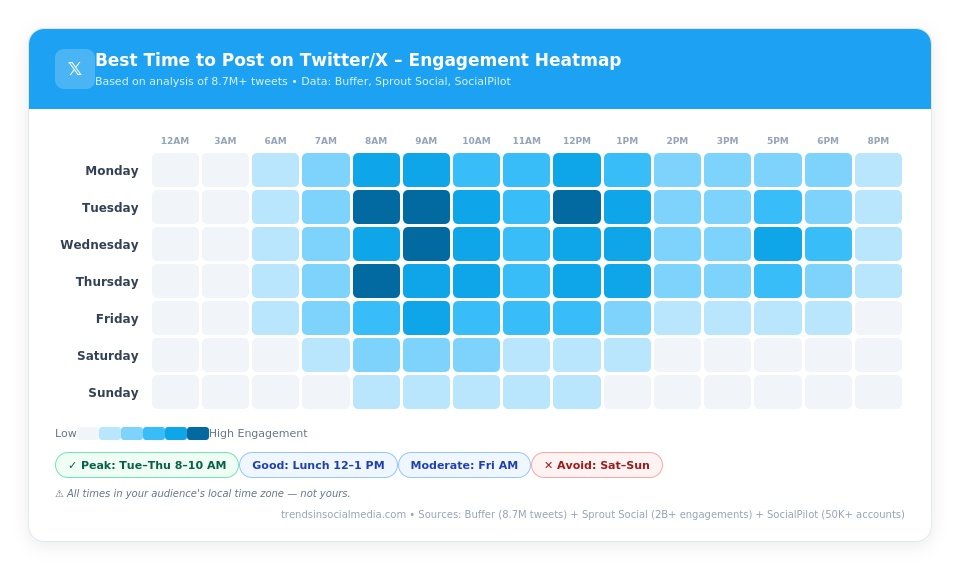
Best overall times to tweet: Monday–Friday, 8 AM – 10 AM and 12 PM – 1 PM (audience’s local time) Single best time slot: Tuesday and Wednesday, 9 AM
Best days to post on Twitter: Tuesday, Wednesday, and Thursday
Worst days to post: Saturday and Sunday
Twitter’s edge: It’s a real-time platform, timing here matters more than on almost any other social network
You craft a sharp, well-worded tweet. Witty, relevant, on-brand. You hit send, and it gets three impressions and a single like from someone who liked it by accident.
Meanwhile, an almost identical tweet from a competitor blows up with thousands of impressions and hundreds of retweets. The difference? Timing.
Twitter (now officially rebranded as X) is unlike any other social platform. It runs in real time. Trending topics rise and fall within hours. Posts don’t have the same algorithmic shelf life they might have on Facebook or Instagram. If you miss the window when your audience is actively scrolling, your tweet is buried and gone before most people ever see it.
In this guide, we’ve pulled together data from multiple independent studies covering millions of tweets to give you the most accurate, actionable breakdown of the best time to post on Twitter in 2026, by day, by hour, by industry, by goal, and by audience type.
Let’s get into it.
Why Timing Matters More on Twitter Than Any Other Platform
Before diving into the data, it’s worth understanding what makes Twitter’s timing dynamics so distinct.
On Facebook or Instagram, the algorithm can surface your content hours or even days after it was posted if it’s generating engagement. Twitter doesn’t work that way, at least not for organic posts.
Twitter’s feed, even with algorithmic ranking enabled, is heavily recency-weighted. A tweet posted an hour ago is functionally ancient in X’s ecosystem. This means:
You need to be posting when your audience is actually online
Early engagement within the first 15–30 minutes determines how widely your tweet gets surfaced Dead-hour posting wastes your content entirely, there’s no second chance for it to resurface later
This real-time nature is also what makes Twitter valuable for brands, journalists, marketers, and creators. But it’s a double edged sword. Master the timing, and your reach is disproportionately large. Get it wrong, and even great content falls flat.
Understanding the algorithm across different platforms is a core part of social media strategy, if you manage other channels too, our guide on how social media algorithms work gives a solid foundation.
Best Times to Post on Twitter in 2026 (Data from Millions of Tweets)
Data from multiple studies, including analyses of 8.7 million tweets (Buffer), 50,000+ Twitter accounts (SocialPilot), and billions of social engagements across platforms (Sprout Social), paints a consistent picture of when Twitter audiences are most active and most likely to engage.
Day Best Posting Times Engagement Level
Monday 8 AM – 10 AM, 12 PM – 1 PM (Good)
Tuesday 8 AM – 10 AM, 12 PM – 1 PM (Excellent)
Wednesday 9 AM, 12 PM – 1 PM, 5 PM – 6 PM (Excellent)
Thursday 8 AM – 10 AM, 12 PM (Excellent)
Friday 8 AM – 11 AM (Average)
Saturday 9 AM – 11 AM only (Low)
Sunday Not recommended (Very Low)
The core insight: The strongest engagement window on Twitter runs Tuesday through Thursday, 8 AM – 10 AM and 12 PM – 1 PM in your audience’s local time zone. These windows align perfectly with morning commute scrolling, morning coffee routines, and lunchtime browsing, moments when people are on their phones with intentional browsing time.
All times listed are in your target audience’s local time zone, not yours.
Best Days to Post on Twitter
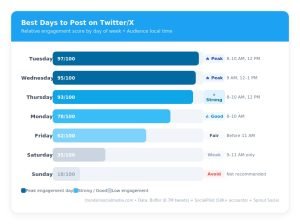
Here’s how each day stacks up based on consistent patterns across multiple studies:
Tuesday, Wednesday & Thursday – Peak Days
The midweek trifecta is where Twitter engagement consistently peaks. Users are fully in their work-week routine, commuting, checking feeds over lunch, or scrolling during brief downtime. Wednesday at 9 AM has been flagged as a standout slot across multiple data sets, it combines the midweek attention spike with the proven morning browsing pattern.
Monday – Strong Opener
Monday performs well in the morning, particularly between 8 AM and 10 AM. People are checking the news, catching up on what they missed over the weekend, and easing into the week, all habits that translate to active Twitter sessions. Avoid Monday afternoons, though; engagement drops significantly after 1 PM.
Friday – Declining Returns
Friday mornings (before noon) can still deliver solid engagement, especially for entertainment, trending news, and casual content. But Friday afternoons are a graveyard on Twitter, people mentally clock out early and weekend disengagement sets in fast. Post before 11 AM on Fridays or skip it.
Saturday & Sunday – Lowest ROI
Weekend Twitter engagement is the weakest across nearly every study and industry. While Twitter users are technically online on weekends, they’re in entertainment/personal browsing mode, less receptive to brand content, professional posts, or product-focused tweets. Unless your data specifically shows a weekend-active audience, save your best content for the weekday windows.
Best Time to Post on Twitter by Hour
Looking at hourly patterns gives you even more precision. Here’s how different time blocks perform throughout the day:
6 AM – 8 AM: Early Birds & Commuters
The absolute earliest active window. A subset of Twitter users, particularly in the US and UK, check their feeds first thing in the morning or during their commute. Not the highest volume window, but engagement rate per impression can be strong because competition is low. Good for news-adjacent or motivational content.
8 AM – 10 AM: Peak Morning Window
This is the golden hour for Twitter. People are settled at their desks, grabbing coffee, or commuting, and Twitter is the go to platform for this exact routine. Engagement rates are highest during this window, and the combination of high activity + relatively low competition makes it the most reliable time to tweet. If you could only pick one window, make it 9 AM on a Tuesday or Wednesday.
10 AM – 12 PM: Strong Mid-Morning
Slightly declining from the 8–10 AM peak but still a solid window. Most people are working, but Twitter is the kind of platform users keep open in the background. Quick-scroll moments between tasks are common during this window.
12 PM – 1 PM: Lunch Hour Spike
A clear secondary peak. Lunchtime is when users step away from work and do a proper, intentional feed scroll. Engagement spikes sharply between 12 PM and 1 PM, particularly for casual, entertaining, and informational content. Excellent window for tweets you want to generate replies and conversations.
1 PM – 4 PM: Post-Lunch Lull
Engagement dips in the early afternoon. People are back at work or in meetings. Not the worst time, but not where you want to be placing your most important content.
5 PM – 6 PM: Evening Commute Window
A moderate secondary spike as people commute home or wind down from the workday. Wednesday and Thursday evenings perform particularly well here. Good for opinion pieces, threads, and content designed to generate discussion.
After 8 PM: Night Owls and News Junkies
Twitter has a committed night-time user base, particularly among news followers, sports fans, and entertainment audiences. If your content is in one of those niches, later evening posts (8 PM – 10 PM) can actually perform well. For general brands and businesses, though, evenings are generally not reliable.
Best Time to Post on Twitter by Industry
Your audience’s Twitter habits are heavily shaped by what they use the platform for. Here’s a breakdown by industry:
Technology & SaaS
Best times: Tuesday – Thursday, 9 AM – 11 AM
Tech Twitter is highly active in the morning, particularly on weekdays
Thought leadership threads and product announcements perform best early in the day
News & Media
Best times: Monday – Friday, 6 AM – 9 AM and 5 PM – 7 PM
News content thrives on Twitter’s real-time nature, breaking news performs whenever it breaks
Morning and commute-home windows are prime for news sharing
E-commerce & Retail
Best times: Wednesday – Friday, 12 PM – 2 PM
Lunch hours and pre-weekend browsing drive the highest purchase intent on Twitter
Promotional tweets and limited-time offers work well mid-week at midday
Entertainment & Pop Culture
Best times: Wednesday – Friday, 7 PM – 10 PM
Entertainment Twitter is one of the most active evening communities on the entire platform
Live-tweeting events, reactions, and commentary peaks during evening hours
B2B & Professional Services
Best times: Tuesday – Thursday, 8 AM – 10 AM
Decision-makers and professionals are most receptive during morning business hours
Avoid evenings and weekends completely for B2B Twitter content
Sports & Fitness
Best times: Weekdays 7 AM – 9 AM, weekends 9 AM – 12 PM
Sports Twitter is uniquely active on weekends — one of the few exceptions to the weekend posting rule Game-day and event-day timing overrides all standard patterns
Food & Restaurants
Best times: Friday 11 AM – 1 PM, Sunday 9 AM – 11 AM
Post content aligned with when people are deciding what to eat, right before meals
Best Time to Tweet for Different Goals
Not all tweets have the same objective. Different goals call for slightly different timing strategies:
Maximum Impressions & Reach
Post during peak traffic windows: Tuesday–Thursday, 8 AM – 10 AM. Higher volume of active users means more eyes on your content, even if individual engagement rates aren’t always highest.
Maximum Replies & Conversations
The lunch hour (12 PM – 1 PM) on Tuesday–Thursday tends to generate the most conversational engagement. People are relaxed, less task-focused, and more likely to stop and reply.
Maximum Retweets & Shares
Morning posts (8 AM – 10 AM) get shared most heavily, people retweet content they discover first thing in the morning to fill their own followers’ feeds throughout the day.
Link Clicks & Website Traffic
Midday posts (12 PM – 1 PM) drive the most link clicks. Users are actively browsing with intent during lunch breaks, more likely to actually follow through and click through to your content.
Breaking News or Trending Topics
Timing is irrelevant here, post the moment the news is confirmed or the trend is identified. Twitter rewards speed more than any other platform. A relevant tweet published immediately outperforms a polished tweet published an hour later when the moment has passed.
Best Time to Post Threads on Twitter/X
Twitter Threads (multi-tweet posts) have become one of the platform’s most powerful content formats for building authority and growing followers. Their timing works slightly differently from single tweets.
Because Threads are designed to be read rather than just scanned, they perform best when users have a bit more time on their hands, not during quick-scroll morning commutes.
Best times for Twitter Threads:
Wednesday or Thursday, 9 AM – 10 AM — best for educational and professional threads
Lunch hour (12 PM – 1 PM) — strong for storytelling, opinion pieces, and how-to threads
Tuesday evening (6 PM – 8 PM) — solid for personal essays and narrative-style content
Threads generally have a longer shelf life on Twitter than single tweets, a well-written thread can continue generating impressions for 24–48 hours as it gets discovered and shared. Early engagement is still critical, though, so timing the initial post well still matters.
Twitter Timing vs. Other Social Platforms
Understanding how Twitter differs from other platforms helps you build a cross-platform schedule that makes sense rather than just mirroring the same timing everywhere:
Twitter/X: Morning-heavy, real-time, weekday-focused, timing here is most critical
Instagram: More flexible; algorithmic distribution gives posts longer life, see our full best time to post on Instagram guide
TikTok: Evening and late-night driven, completely different from Twitter, covered in our best time to post on TikTok guide
If you’re managing content across multiple platforms, avoid the temptation to post everything simultaneously. Stagger your schedule to respect each platform’s unique peak windows.
How to Find the Best Time to Post on Twitter for YOUR Audience
Industry benchmarks are a reliable starting point, but your specific audience is unique. Here’s a step-by-step process to find your personal optimal posting windows:
Step 1: Check Twitter Analytics
Twitter/X has built-in analytics at analytics.twitter.com. It shows you when your followers are most active, which tweet types get the most engagement, and which individual tweets have performed best historically. Use the “Top Tweets” section to spot patterns in what time your high-performing posts went live.
Step 2: Run Posting Time A/B Tests
For 4–6 weeks, post similar content at different times on the same days. Track impressions, engagement rate, link clicks, and retweets for each. Over time, clear patterns will emerge, usually two or three specific windows consistently outperform the rest.
Step 3: Analyse Your Top 15 Posts
Pull your 15 highest-performing tweets from the past 90 days. Note the day and time of each. Look for clustering, if 10 of your 15 best posts went live between 8 AM and 10 AM on weekdays, that’s your answer.
Step 4: Use a Scheduling Tool With Timing Recommendations
Tools like Buffer, Hootsuite, Typefully, and SocialPilot analyse your historical Twitter performance and generate personalised timing recommendations. These tools are far more precise than global benchmarks because they’re working from your actual audience data. Our guide on how to schedule tweets covers the best scheduling tools and workflows in detail, it’s worth reading if you want to build a consistent, automated posting system.
Step 5: Account for Time Zone Differences
This is a big one that catches many people out. If your audience is primarily in the US (Eastern Time) and you’re scheduling posts from the UK or Pakistan, an 8 AM EST tweet needs to be scheduled for 1 PM GMT / 6 PM PKT. Always post in your audience’s local time, not yours.
Practical Twitter Posting Schedule Template
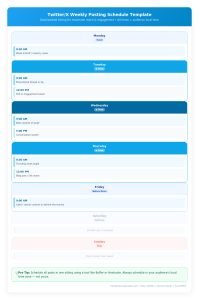
Here’s a practical weekly template to use as your starting point, based on the data above:
Day Time Content Type
Monday 8:30 AM Week kickoff — industry news, motivational, or opinion tweet
Tuesday 9 AM + 12 PM 9 AM: Educational thread or tip. 12 PM: Engagement question or poll Wednesday 9 AM + 5 PM 9 AM: Your highest-value content. 5 PM: Reply/conversation-starter tweet Thursday 8:30 AM + 12 PM 8:30 AM: News or trending topic angle. 12 PM: Link share / blog post Friday 9 AM Casual, lighter content, behind-the-scenes, humour, or a weekend roundup
Saturday Skip or 10 AM Optional: community or entertainment content only
Sunday Skip Save energy for Monday’s peak window
Adjust these slots over time as your own Twitter Analytics data reveals what’s working best for your specific audience.
Worst Times to Post on Twitter
Equally important, here are the windows to consistently avoid for important content:
10 PM – 6 AM (any day): Almost no active engagement in US/UK markets, essentially a dead zone for organic reach
Saturday afternoon (after 1 PM): Engagement craters as people shift to offline weekend activities Sunday all day: The single weakest day for brand and professional content on Twitter, consistently bottom of every study
Monday before 8 AM: People are still easing into the week and not yet in active-browsing mode Friday after 2 PM: Weekend disengagement starts early, save that tweet for Tuesday morning
Twitter Posting Frequency: How Often Should You Tweet?
Timing is half the equation. Frequency matters too. Here’s what the data suggests:
Minimum viable: 3–5 tweets per week to maintain visibility and signal account activity to the algorithm Growth mode: 1–3 tweets per day, spread across peak windows
Aggressive growth: 3–5 tweets per day including replies, retweets with comment, and original posts, this is what many high-growth creators do
Unlike Facebook, Twitter doesn’t penalise higher frequency as harshly, the real-time nature of the platform means multiple posts per day is normal and expected. That said, quality should never be sacrificed for volume. Three excellent tweets scheduled strategically will always outperform ten mediocre ones scattered randomly throughout the day.
Tips to Maximize Engagement After Tweeting
Timing gets your tweet in front of people. Here’s what you do after it goes live:
1. Engage With Replies Within the First 30 Minutes
Replying to early comments signals high activity to Twitter’s algorithm and extends the engagement lifecycle of your tweet. Early replies from you also often show up in other users’ feeds, bringing additional impressions.
2. Use the Right Number of Hashtags
Twitter is unusual among social platforms in that fewer hashtags generally perform better. Data consistently shows that tweets with 1–2 relevant hashtags outperform those with 5+. Hashtag stuffing looks spammy and dilutes your content.
3. Attach Native Media
Tweets with images, GIFs, or native videos get significantly more engagement than text-only tweets. If you’re sharing a link, Twitter automatically generates a card preview, make sure your linked page has proper Open Graph meta tags so the preview looks professional. Free image resources for your posts are covered in our guide to the best free image sources for social media.
4. Pin Your Best-Performing Tweet
Regularly update your pinned tweet with your highest-quality, most relevant content. It’s prime real estate on your profile and one of the first things new visitors see, make it work hard for you.
5. Repurpose Top Performers
Twitter’s short shelf-life means great content can be recycled every 4–8 weeks without most followers noticing. Track your highest-performing tweets and reshare (or rewrite) them during peak windows several weeks later.
6. Join Trending Conversations Quickly
Trending hashtags and topics can deliver massive reach boosts, but only if you participate while the trend is still hot. Monitor Twitter Trends regularly and have a system in place to create and publish reactive content fast when a relevant trend emerges.
7. Schedule Tweets in Advance
Manually tweeting at exactly 9 AM every Tuesday is impractical if you’re managing a full social media calendar. Use a scheduling tool and build your weekly queue in one sitting. The full workflow is covered in our step-by-step guide on how to schedule tweets, including the best free and paid tools to use.
Common Twitter Timing Mistakes to Avoid
Posting in your own timezone instead of your audience’s: The most common and costly mistake. Always schedule in your audience’s local time.
Treating Twitter like Instagram: Instagram content can surface days later; Twitter content cannot. Real-time platform = real-time urgency.
Ignoring your analytics completely: Global benchmarks are a starting point, not a permanent prescription. Your own data will show you better windows within a few weeks of tracking.
Posting too infrequently: With Twitter’s short content shelf-life, not tweeting enough means you simply disappear from your audience’s feeds.
Saving all posts for one day: Spreading posts evenly across 3–4 days consistently outperforms dumping all content on one heavy posting day.
Ignoring trending opportunities because “it’s not the right time”: Relevance overrides timing on Twitter. If something trending is relevant to your brand, post immediately regardless of the hour.
Final Thoughts
The best time to post on Twitter isn’t a single universal answer you apply once and forget, it’s a dynamic practice that requires regular data review and adjustment.
Start with the benchmarks from this guide:
Focus your core posting on Tuesday, Wednesday, and Thursday
Hit the 8 AM – 10 AM morning window and the 12 PM – 1 PM lunch spike as your primary slots Avoid weekends for important content unless your audience data says otherwise
Use Twitter Analytics to validate and refine your specific windows over time
Schedule ahead with a proper tool, manual posting at exact times every day isn’t sustainable
Pair smart timing with high-quality content, genuine audience engagement, and a consistent posting cadence, and you’ll see measurable improvement in your Twitter reach, impressions, and follower growth within weeks.
For more social media strategy, explore our resources on social media marketing careers and strategy.
Frequently Asked Questions
What is the single best time to post on Twitter for maximum engagement?
Based on the most current data across multiple large-scale studies, Tuesday and Wednesday between 9 AM and 10 AM in your audience’s local time zone consistently deliver the highest engagement rates. This captures the peak morning browsing window when Twitter activity is at its daily high point.
Is there a best time to post on Twitter on weekends?
Weekend engagement on Twitter is significantly lower than weekday performance for most industries. If you need to post on weekends, Saturday between 9 AM and 11 AM is the best available window. Sunday is the weakest day for Twitter engagement across virtually every study, it’s best avoided for important content.
Does the best time to post on Twitter differ by industry?
Yes. News and media brands can post early (6 AM – 8 AM) because that audience actively checks Twitter for morning news. Entertainment brands do well with evening posts (7 PM – 10 PM). B2B brands should stick strictly to weekday mornings (8 AM – 10 AM). Sports accounts are one of the few categories where weekends can actually outperform weekdays during game days or major events.
Does it matter what time I post for Twitter ads?
For paid Twitter ads, Twitter’s ad delivery system optimises timing automatically. However, starting a promoted post during a high-engagement organic window typically gives it stronger initial social proof (likes, retweets) that can reduce your cost per-engagement and improve overall performance.
How do I find the best time to tweet for my specific account?
Use Twitter Analytics (analytics.twitter.com) to see when your followers are most active. Then run A/B tests by posting similar content at different times and comparing performance over 4–6 weeks. A scheduling tool with analytics integration will give you even more precise recommendations based on your account’s historical data.
How often should I tweet for best results?
For most accounts, 1–3 tweets per day on weekdays strikes the right balance between visibility and quality. High-growth accounts tweet more aggressively (up to 5+ times daily including replies), but quality consistency is always more important than raw volume.
Is Twitter/X still worth investing in for businesses?
Despite the platform’s rebrand and various changes under new ownership, Twitter/X remains one of the most powerful platforms for real-time engagement, news distribution, B2B thought leadership, and community building. With a strategic posting schedule and consistent content, it’s absolutely still worth investing in, especially for brands targeting US and UK audiences.
