

Comments are the part of Instagram that feels most like a conversation. A like says “I saw this”, a save says “I’ll need this later”, but a comment says “I have something to add”. For creators and brands, comments are also some of the most useful feedback available, revealing what people care about, what confuses them and what they want to see next.
Yet many accounts with healthy reach still see quiet comment sections. The reason is rarely the content itself. More often, the caption gives people nothing to respond to. This guide looks at why comments matter, which caption prompts reliably start conversations on different formats, and how replying turns a handful of comments into a genuine thread.
Why Comments Still Count
Instagram has said that its ranking system predicts how likely someone is to comment on a post, alongside other actions such as liking, saving and sharing (Instagram Ranking Explained). A post that draws comments is one people are actively engaging with, and that engagement helps the app decide what to show more of.
Different formats attract comments differently. Socialinsider’s 2026 benchmarks found that Reels draw the most comments on average, while carousels lead on saves (Socialinsider). That doesn’t mean carousels and photos can’t spark discussion; it means the prompt has to do more of the work. Comment sections also act as a public signal for new visitors, who often scroll through them to decide whether an account’s community is worth joining.
The Problem With “Thoughts?”
Many captions end with a generic question such as “Thoughts?” or “Let me know in the comments!” These rarely work, because they ask people to come up with something interesting to say from scratch. The best prompts lower that effort. They ask something specific, easy to answer and personal enough that people want to share their own version.
There is also a difference between prompts that start conversations and prompts that simply farm engagement. Asking people to “comment YES if you agree” may produce a flurry of one-word replies, but it rarely builds anything lasting, and Meta has long discouraged engagement bait across its apps. Prompts that invite real opinions, experiences or advice produce comments worth reading and replying to.
Prompts That Work on Reels
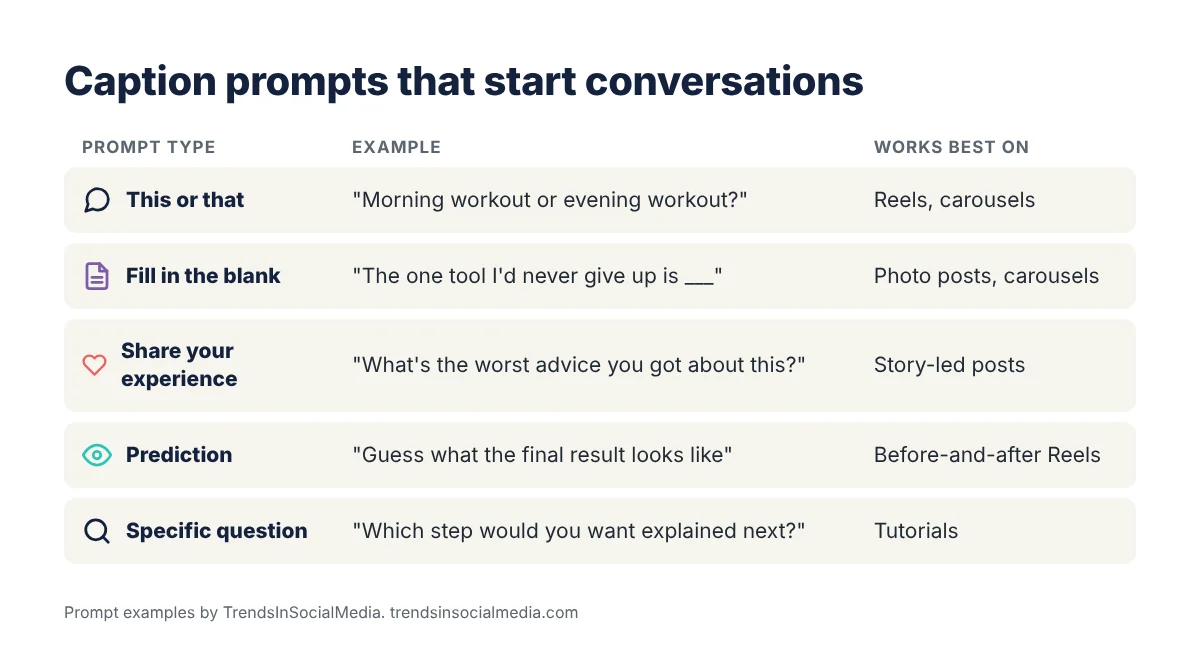
Reels move quickly, so the prompt should connect directly to the video and ideally appear on screen as well as in the caption. Asking viewers to pick between two options shown in the clip works well, as does asking them to guess an outcome before the reveal or to share how they would have handled a situation. A cooking creator might ask which step people always skip; a fitness creator might ask which exercise viewers find hardest. The more the question builds on what the viewer has just watched, the easier it is to answer.
Prompts That Work on Carousels and Photos
Carousels are often educational, so a strong prompt asks people to add to the list. If a carousel covers five tips, asking followers to share the sixth turns the comment section into an extension of the post. Questions about personal experience work well too, such as which tip someone already uses or which mistake they’ve made themselves. For single photos, asking about the story behind the image, or inviting people to share their own photo from a similar place or moment, usually draws warmer and longer replies than asking for an opinion.
Creators who struggle to come up with fresh prompts can borrow from a year’s worth of caption ideas and adapt them to their own niche. The key is to rewrite each one so it sounds like the account’s normal voice, rather than pasting the same line every time.
Reply to Turn Comments Into Conversations
The first hour after posting matters. Replying to early comments with something more than an emoji, ideally with a follow-up question, signals to other viewers that comments are read and valued, and it often brings the original commenter back for a second reply. Instagram’s threaded comments make these exchanges easy to follow (About Instagram), and pinning a particularly good comment to the top gives new visitors a conversation to join.
Replies don’t have to be instant all day. A simple routine of checking back after the first hour, then again later that day, keeps conversations alive without taking over a creator’s schedule. Accounts that make followers feel heard tend to build communities that comment by habit, which is one of the subtle cues explored in the hidden signals that make a social media profile stand out.
Getting Comment Sections Started
An empty comment section can discourage people from going first. Some accounts tackle this by working with a creator growth agency or by ordering custom Instagram comments on key posts, such as a launch announcement. Anyone considering that should know that Instagram removes comments it considers inauthentic, and that the FTC’s 2024 rule targets fake indicators of social media influence used to mislead for commercial purposes. Comments that read like real reactions to the content, and that the account replies to, will always do more than generic praise.
The most sustainable route is content people want to talk about. Posts that touch on shared experiences, mild debates or useful advice naturally invite responses, and the same qualities often make them worth sharing, as explained in why some social media posts get shared more than others.
The Takeaway
Getting more comments on Instagram starts with the caption. Swap vague questions for specific, easy-to-answer prompts that build on what people just saw: choices and predictions on Reels, “add your own tip” on carousels and personal stories on photos. Then reply quickly and thoughtfully, pin the best responses and keep checking back. Comment sections grow when people believe someone is listening, and that belief is built one reply at a time.
