
 By Paul Walker
Ever picked the restaurant with the longer line instead of the empty one next door? That’s social proof, and it quietly drives most of the decisions you make online and offline every day.
What Is Social Proof? (Quick Answer)
Social proof is a psychological phenomenon where people copy the actions or choices of others because they assume that behavior is correct. It shows up as reviews, ratings, follower counts, testimonials, and “most popular” labels, and it works because humans use other people’s decisions as a shortcut for their own, especially when they’re uncertain.
The term was popularized by psychologist Robert Cialdini in his 1984 book Influence, and it’s now one of the most widely used principles in marketing, e-commerce, and social media growth.
Why Social Proof Works
Social proof isn’t a marketing trick invented in a boardroom, it’s a survival instinct. Early humans who followed the group’s lead (run when others run, eat what others eat) survived more often than those who didn’t. That wiring hasn’t disappeared; it’s just moved online.
Today it shows up as:
- Choosing a product with 4,000 reviews over one with 12
- Trusting a creator with a large, active following over a brand-new account
- Assuming a busy restaurant is better than an empty one
- Following a friend’s recommendation over an ad
Social proof often overrides logic. You might book a hotel your friends liked on Facebook even if a competitor offers the same amenities at a lower price, because trust, not just facts, drives the decision. This is also why what makes a social media profile look trustworthy matters so much before someone even reads your content: people judge credibility in seconds, and social proof is the fastest signal they use to do it.
6 Types of Social Proof
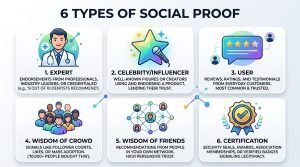
1. Expert Social Proof
Endorsements from professionals, industry experts, or credentialed sources, think “9 out of 10 dentists recommend.”
2. Celebrity/Influencer Social Proof
A well-known figure or creator using or endorsing a product, lending their audience’s trust to the brand.
3. User Social Proof
Reviews, ratings, and testimonials from everyday customers, the most common and most trusted form online.
4. Wisdom of the Crowd
Signals like follower counts, likes, or “10,000+ people bought this” that show mass adoption.
5. Wisdom of Friends
Recommendations from people in your own network, arguably the most persuasive type, since it comes with built-in trust.
6. Certification Social Proof
Security seals, awards, association memberships, or verified badges that signal legitimacy and safety.
Real-World Examples of Social Proof
- A hotel sign reading that most previous guests reused their towels, a real study found this framing increased towel reuse more than a standard environmental message did
- Customer reviews and star ratings on e-commerce product pages
- “As seen in” logos from press or partner brands on a website
- Verified badges and follower counts on social profiles
- Real-time notifications like “23 people bought this in the last hour“
- Case studies and client logos on a services page
- A petition page showing how many people have already signed
Even sustainability campaigns lean on this principle, researchers at Portland State University used social proof messaging to nudge people toward more environmentally conscious purchasing decisions, closing the gap between what people say they value and what they actually do.
Social Proof in Marketing: What the Data Shows
Social proof isn’t just theory, it directly affects buying behavior. According to Statista, 76 percent of US consumers regularly read online reviews before deciding whether to use a local business. That single number explains why review counts, ratings, and testimonials now sit at the top of product pages, not buried in the footer.
For businesses, this means social proof does three things at once:
- Builds credibility faster than any ad copy can
- Reduces perceived risk for a first-time buyer or follower
- Increases conversion rates by removing hesitation at the decision point
How to Build Social Proof (Practical Checklist)
You don’t need a huge budget to build social proof, you need consistency and visibility. Start here:
- Actively request reviews and testimonials from happy customers
- Highlight case studies and measurable results on your site
- Display trust badges, certifications, and association memberships
- Partner with niche-relevant creators or micro-influencers
- Make sharing effortless, add share buttons and encourage tagging
- Optimize your Google Business Profile so local social proof surfaces in search
- Publish real customer numbers (“Join 12,000+ subscribers“) where honest and accurate
Social Proof on Social Media (Why It Matters More Here)
On social platforms, social proof isn’t a nice-to-have, it’s the entire ranking and trust system. A profile with strong engagement gets more reach, more credibility, and more organic followers, because both the algorithm and human visitors read activity as a quality signal.
This is also why accounts sometimes get stuck even when posting daily, thin engagement signals tell both the algorithm and new visitors there’s nothing worth sticking around for. If that sounds familiar, it’s worth reading why social media growth stalls even when you post daily for a deeper breakdown of what’s actually happening behind the scenes.
The same logic applies to shareability. Posts with early traction get pushed further because shares tell the platform the content is worth spreading, a compounding effect explained well in why some social media posts get shared more than others.
For creators and brands trying to establish that initial trust signal, follower and engagement counts are usually the first thing a new visitor checks before deciding to follow, buy, or collaborate. Services like SoldOutX exist specifically to help new or growing accounts close that early gap, giving a profile enough visible momentum that organic visitors take it seriously from the first glance. If followers are the piece you’re missing, SoldOutX’s Buy Instagram Followers service is built around exactly this use case: strengthening the social proof signal while your content and community catch up naturally.
FAQs About Social Proof
What is an example of social proof in everyday life?
Choosing a busy restaurant over an empty one, or buying a product because it has thousands of five-star reviews, are both everyday examples of social proof in action.
What is the difference between social proof and FOMO?
Social proof is about trusting the crowd’s judgment (“many people chose this, so it must be good”). FOMO (fear of missing out) is about urgency and scarcity (“I need to act now before I miss it”). They often work together but aren’t the same mechanism.
Does social proof still work if people know it’s a marketing tactic?
Yes. Studies consistently show that even when people recognize social proof as a persuasion technique, it still influences their decisions, because the underlying trust-in-numbers instinct operates below conscious awareness.
Is it okay to buy followers to build social proof?
It depends entirely on how it’s done and paired with real strategy, this is covered in detail in SoldOutX’s guide on whether it’s okay to buy Instagram followers, which breaks down the risks, the right way to do it, and how it fits alongside organic growth.
What industries benefit most from social proof?
E-commerce, health care, hospitality, and social media/influencer marketing see the strongest impact, since all four involve high-uncertainty decisions where buyers actively look for validation from others before committing.