
 By Paul Walker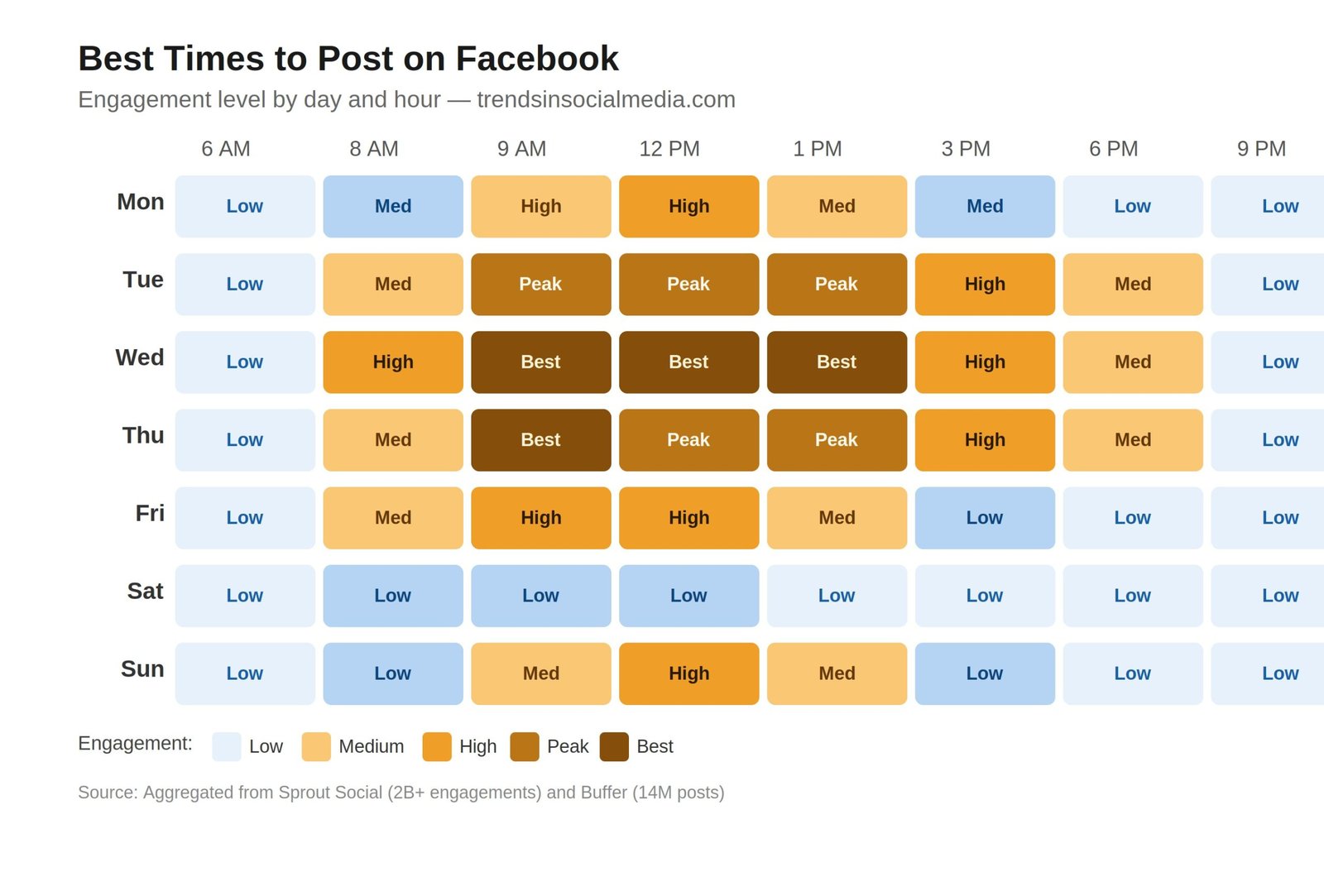
Quick Answer: The best times to post on Facebook are Tuesday through Thursday, between 9 AM and 1 PM. Multiple large-scale data studies consistently point to mid-week mornings as the sweet spot for engagement, reach, and clicks. That said, your perfect window depends on your industry, audience time zone, and content format, all of which we’ll cover in detail below.
Why Posting Time Matters on Facebook
Facebook has over 3.07 billion monthly active users, making it the most populated social network on the planet. That also means competition for attention is fierce. With thousands of posts fighting for space in every user’s feed, timing isn’t just a detail. It’s a strategic advantage.
Here’s why it matters:
The Facebook algorithm rewards early engagement. When your post first goes live, Facebook shows it to a small sample of your audience. If those people react, comment, or share within the first 30–60 minutes, the algorithm interprets it as high-quality content and expands its distribution. Post when no one’s online, and your content quietly dies before it ever gets a chance.
Recency is still a ranking signal. While Facebook’s algorithm is heavily personalised, it still factors in how recently a post was published. Posting during peak scrolling hours means you’re more likely to land at or near the top of your followers’ feeds.
It compounds over time. Brands that consistently post at optimal times build stronger engagement averages, which signals to the algorithm that their page consistently produces valuable content. This creates a positive feedback loop, better timing → better early engagement → broader reach → more followers → better future results.
Getting the timing right won’t save bad content, but it absolutely amplifies good content. Combined with a solid content strategy, it can meaningfully accelerate your Facebook page growth.
Best Times to Post on Facebook – Combined Data
Rather than relying on a single study, we’ve pulled together findings from multiple major data sources to give you the most accurate picture possible.
Based on multiple large-scale studies, the best times to post on Facebook consistently fall in the mid-week window. Sprout Social, drawing from nearly 2 billion engagements across 307,000+ profiles, identifies Tuesday and Wednesday between 12 PM and 8 PM as the top-performing window. Buffer’s analysis of 14 million Facebook posts points to Thursday at 9 AM as the single best time slot.
HubSpot’s industry-wide survey data suggests Wednesday through Friday between 1 PM and 3 PM, while CoSchedule’s aggregation of 20+ studies highlights Wednesday between 11 AM and 1 PM as the sweet spot. Adobe Express, based on broad platform analysis, recommends weekdays generally between 9 AM and 2 PM. Across all five sources, the consensus is clear, mid-week mornings to early afternoons deliver the strongest engagement on Facebook.
What the data agrees on:
- Mid-week (Tuesday to Thursday) is consistently the top-performing window across all major studies
- Mornings (9 AM – 11 AM) and early afternoons (12 PM – 2 PM) are peak engagement periods
- Saturdays are widely cited as the worst day to post
- Late nights and early mornings (after 10 PM or before 7 AM) are dead zones for most audiences
The consensus best time to post on Facebook: Tuesday, Wednesday, or Thursday between 9 AM and 1 PM in your audience’s local time zone.
Best Time to Post on Facebook – Day-by-Day Breakdown
Let’s get specific. Here’s what the data says about each individual day:
Monday
Best time: 9 AM – 12 PM
Monday engagement is decent but not outstanding. People are easing back into their work week, checking emails, and getting organised. They do scroll Facebook, but engagement is lighter than mid-week. If you post on Mondays, aim for the late morning window before the afternoon dip kicks in. Motivational content and educational posts tend to perform well as people are in a goal-setting mindset.
Tuesday
Best time: 9 AM – 2 PM
Tuesday is one of the strongest days for Facebook posts. Audiences are fully into their working rhythm, and engagement climbs steadily from mid-morning through early afternoon. Data from Sprout Social identifies Tuesday as one of the top two performing days. Publish informational posts, how-to content, or product highlights between 9 AM and 2 PM for the best results.
Wednesday
Best time: 11 AM – 1 PM (peak), sustained until 8 PM
Wednesday is the single best day to post on Facebook according to Buffer’s analysis of 14 million posts. It consistently shows the highest engagement rates of any day, particularly around the midday window. Multiple studies rank Wednesday as the number one day. If you can only post once this week, make it Wednesday morning or lunchtime.
Thursday
Best time: 9 AM – 12 PM and 8 PM
Thursday closely rivals Wednesday in performance. Buffer’s data identifies Thursday 9 AM as the single best posting time across the entire week. There’s also an interesting secondary engagement spike around 8 PM on Thursdays, likely tied to people winding down after work and browsing social media in the evening. If you have premium content to share, Thursday morning is a safe bet.
Friday
Best time: 10 AM – 12 PM
Friday engagement is decent in the morning but drops sharply in the afternoon as people mentally check out for the weekend. Posts that are lighter, entertaining, or community-focused tend to do better than heavy educational content on Fridays. Think polls, fun facts, memes, or behind-the-scenes content. Post before 12 PM or save your best content for next week.
Saturday
Best time: 10 AM – 11 AM (limited window)
Saturday is, across the board, the worst day to post on Facebook for most businesses. People are occupied with personal activities, and organic reach tends to drop significantly. If you must post, the only viable window is early morning between 10 AM and 11 AM. Avoid Saturday posting unless you run a leisure, hospitality, or entertainment brand where weekend activity is core to your audience’s behaviour.
Sunday
Best time: 11 AM – 1 PM
Sunday performs better than Saturday but still trails weekdays. Audiences are more relaxed and in browsing mode, which can work in your favour for longer-form content, lifestyle posts, or inspirational content. Buffer’s data shows Sunday mornings are actually competitive, particularly for lifestyle and consumer brands. If your audience skews towards personal interests rather than professional, Sunday could be worth testing.
Best Days to Post on Facebook
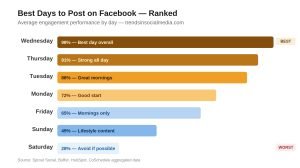
Ranking all seven days from best to worst based on aggregated data:
- Wednesday — Highest overall engagement, especially 11 AM – 1 PM
- Thursday — Strong performance, best single time slot (9 AM)
- Tuesday — Consistently high engagement through the afternoon
- Monday — Decent morning performance, drops in the afternoon
- Friday — Good mornings only, sharp afternoon decline
- Sunday — Better than Saturday, good for lifestyle content
- Saturday — Worst day for most businesses and content types
Key takeaway: If you’re posting 3–4 times per week, concentrate your posts on Tuesday, Wednesday, and Thursday for maximum impact.
Worst Times to Post on Facebook
Avoiding these windows is just as important as targeting the best ones:
- Late night (after 10 PM): Audience is asleep or winding down with little intent to engage
- Early morning (before 7 AM): Very low active users, and posts quickly get buried before peak hours
- Saturday afternoons (2 PM – 6 PM): Consistently the lowest engagement window of the entire week
- Friday afternoons (2 PM – 5 PM): Audiences shift into weekend mode and tune out from brand content
- Public holidays: Reach often drops as algorithm prioritises personal content
If you’ve posted during these slots and seen poor results, it’s almost certainly a timing issue rather than a content problem.
Best Time to Post Facebook Reels
Facebook Reels operate differently from standard posts. Video content, especially short-form video, has a longer shelf life because Facebook actively recommends it to new audiences beyond your existing followers. However, that initial push still depends on timing.
Best times to post Facebook Reels:
- Tuesday – Thursday: 9 AM – 12 PM
- Friday: 8 AM – 10 AM (before the afternoon slump)
- Sunday: 10 AM – 12 PM (for lifestyle and entertainment content)
Reels benefit from posting slightly earlier than standard posts because the algorithm uses that first-hour engagement data to determine distribution. The faster a Reel picks up views and interactions, the wider its reach becomes.
Tips for Facebook Reels timing:
- Post Reels during commuting hours (7 AM – 9 AM) or lunch breaks (12 PM – 1 PM) when people are watching short videos on their phones
- Trending audio and Reels templates tend to get algorithmic boosts regardless of timing, combine both for the best results
- Don’t post Reels late at night expecting morning traction; the algorithm evaluates early engagement velocity
Best Time to Post Facebook Stories
Facebook Stories disappear after 24 hours, which means timing is critical. Unlike feed posts, Stories don’t accumulate engagement over days, they need to be seen while they’re live.
Best times to post Facebook Stories:
- Weekdays: 8 AM – 10 AM (before the workday starts)
- Lunch: 12 PM – 1 PM (quick browsing during breaks)
- Evening: 7 PM – 9 PM (post-work scrolling)
Stories are best used for time-sensitive content: flash sales, event announcements, polls, behind-the-scenes footage, or Q&As. Post at least one Story per day if you’re trying to stay top-of-mind with your followers.
Because Stories are viewed in chronological order, posting multiple Stories throughout the day is more effective than dumping them all at once.
Best Time to Post on Facebook by Industry
Audience behaviour varies significantly by industry. The data-backed general windows are a good starting point, but here’s a more tailored breakdown:
E-commerce & Retail
Best times: Wednesday and Thursday, 12 PM – 2 PM; Friday 10 AM – 12 PM
Shoppers browse during lunch breaks and on Fridays before the weekend. Promotional posts, product drops, and discount announcements perform well in the early afternoon. If you manage a Facebook Marketplace listing or run an online shop, these windows are especially valuable.
B2B & Professional Services
Best times: Tuesday – Thursday, 9 AM – 11 AM
Business audiences are most receptive to professional content at the start of the workday. Thought leadership posts, case studies, and industry insights should be published during business hours. Avoid evenings and weekends for B2B content.
Health, Fitness & Wellness
Best times: Monday, Wednesday, Friday: 7 AM – 9 AM; Sunday 8 AM – 11 AM
The fitness audience is early-rising and motivated. They’re most active before work or on Sunday mornings planning their week. Motivational content, workout tips, and wellness routines perform best in these early slots.
Food & Beverage / Restaurants
Best times: Friday 11 AM – 1 PM; Saturday 10 AM – 12 PM; Sunday 10 AM – 12 PM
People plan their meals and dining experiences around the weekend. Posting mouth-watering food photos or promotional offers on Friday lunchtime and Sunday morning aligns with peak decision-making moments.
Entertainment & Media
Best times: Fridays 3 PM – 5 PM; Saturday and Sunday 11 AM – 2 PM
Entertainment audiences are most active in the evening and on weekends when people are relaxing and looking for things to watch, listen to, or discover.
Non-profits & Causes
Best times: Wednesday and Thursday, 10 AM – 12 PM
Cause-driven content performs well mid-week when audiences are most emotionally engaged and likely to act on appeals, donations, or share campaigns.
How to Find Your Own Best Time to Post on Facebook
The industry averages above are a strong starting point, but your best time to post is ultimately determined by your specific audience. Here’s how to find it:
Step 1: Use Facebook Page Insights
If you have a Facebook Page with at least a few hundred followers, you have access to free analytics. Go to your Page → Insights → Posts → When Your Fans Are Online. This shows you a day-and-hour heatmap of when your specific audience is most active.
This is the most accurate data you’ll ever get because it’s based entirely on your own followers, not industry averages.
Step 2: Run a Posting Time Experiment
Pick three different time slots (e.g., 9 AM, 12 PM, and 6 PM) and post similar content at each time over two weeks. Track engagement rate, reach, and click-through rate for each slot. The results will quickly reveal which window your audience responds to.
Step 3: Segment by Content Format
Different content formats may perform better at different times. Video might peak in the evening; informational posts might do better at 10 AM. Run separate experiments for each content type you regularly publish.
Step 4: Account for Time Zones
If your audience is spread across multiple time zones (common for international brands and those targeting UK and US audiences), you may need to stagger your posts or run multiple versions targeting each region. Aim for a time that captures the bulk of your audience, typically splitting the difference between major time zones.
Step 5: Iterate Monthly
Audience behaviour shifts with seasons, trends, and world events. What works in January may not work in July. Review your Facebook Insights monthly and adjust your posting schedule accordingly.
How Often Should You Post on Facebook?
Getting the time right is only half the equation. Frequency matters too.
Recommended posting frequency by account type:
How often you should post on Facebook depends largely on the size and nature of your account. Small businesses and individual creators are best served posting 3 to 5 times per week — enough to stay consistent without sacrificing quality. Mid-size brands can push that to 5 to 7 times per week, while large brands with a dedicated content team can comfortably post 1 to 2 times per day.
Facebook Groups and community pages operate differently from standard pages, and can sustain a much higher frequency of 2 to 5 posts per day given the community-driven nature of engagement. Regardless of account type, the golden rule remains the same — quality always wins over quantity, and flooding your audience with low-effort content will hurt your engagement rate more than a leaner, well-planned schedule ever would.
Quality always beats quantity. Posting 7 days a week with mediocre content will harm your engagement rate more than posting 3 times a week with strong content. The Facebook algorithm tracks your historical engagement average — if you flood your audience with posts that get low interaction, it will reduce the reach of future posts.
If you’re managing your posting schedule across multiple platforms, you’re probably also thinking about the best time to post on Instagram, best time to post on TikTok, best time to post on Twitter/X, and best time to post on YouTube. Each platform has a different peak window, so a cross-platform content calendar helps you manage all of them without burning out.
Tips to Maximize Facebook Engagement Beyond Timing
Nailing your posting time is powerful, but combine it with these strategies and your results will be significantly stronger:
1. Hook in the First Line
Facebook truncates most posts with a “See more” cutoff. Your opening line needs to grab attention and earn the click to expand. Ask a question, lead with a bold statement, or open with a surprising stat. Avoid burying your hook halfway down.
2. Use High-Quality Visuals
Posts with images or video consistently outperform text-only posts. For static images, use bright, contrast-rich visuals with minimal text overlay. For video, the first 3 seconds are everything — auto-play starts silent, so visual storytelling matters from frame one.
3. Write a Strong Call to Action
Tell your audience exactly what you want them to do: “Drop your answer in the comments,” “Tag someone who needs to see this,” or “Click the link to read the full guide.” Explicit CTAs dramatically improve engagement and click-through rates.
4. Engage Immediately After Posting
In the first 30–60 minutes after you publish, respond to every comment. This signals to Facebook that your post is generating active conversation, which triggers broader distribution. Set a reminder to be available right after you schedule a post.
5. Leverage Facebook Groups
Facebook Groups generate significantly higher organic reach than Pages because users see group posts more reliably. If you’re in your niche or run your own Facebook community, posting valuable content in groups can drive 3–5x more engagement than the same post on a Page.
6. Use Native Facebook Features
Facebook prioritises content created and hosted within its platform. Native video (uploaded directly to Facebook rather than shared from YouTube), Facebook Reels, Live videos, and Polls all tend to receive a reach boost compared to outbound links. Use these formats regularly in your content mix.
7. Schedule Posts in Advance
Consistency is key, and manual posting at the exact right time every day isn’t realistic. Use Facebook’s native scheduling tool (Creator Studio or Meta Business Suite) to plan posts in advance and ensure you never miss a peak window. Third-party tools like Buffer or Sprout Social also integrate peak-time recommendations directly into their scheduling dashboards.
Conclusion
The best time to post on Facebook isn’t a single magic hour — it’s a consistent strategy of posting mid-week, in the morning to early afternoon, based on your audience’s time zone and behaviour.
Summary of the best times to post on Facebook:
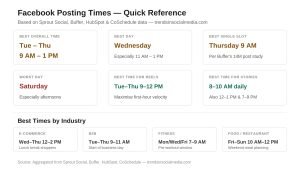
- Overall best time: Tuesday–Thursday, 9 AM – 1 PM
- Best single day: Wednesday
- Best single time slot: Thursday 9 AM
- Worst day: Saturday
- Avoid: Late nights, early mornings, and Saturday afternoons
Use Facebook Page Insights to validate these findings against your own audience data, run structured posting experiments, and refine your schedule monthly. The brands that win on Facebook are the ones that combine smart timing with consistent, high-quality content.
For anyone exploring opportunities in this space, the demand for social media expertise continues to grow — check out the latest social media marketing jobs if you’re looking to turn your knowledge into a career. And if you’re managing Meta’s expanding ecosystem, don’t miss our guide on using Meta Threads as part of your overall Facebook and Meta strategy.
Start with Wednesday at 11 AM, measure your results, and optimise from there. Timing your posts correctly is one of the fastest, lowest-effort wins available to any Facebook marketer.
Frequently Asked Questions
What is the best time to post on Facebook for maximum likes?
The best times for maximum likes on Facebook are Tuesday through Thursday between 9 AM and 12 PM. This mid-week morning window sees the highest concentration of active users combined with peak willingness to engage with content.
Is it better to post on Facebook in the morning or at night?
Morning consistently outperforms night-time posting for most industries. Engagement drops significantly after 9 PM for the majority of audiences. The exception is entertainment brands and international accounts spanning night-time active time zones.
What is the best time to post on Facebook on weekends?
The best time to post on Facebook on weekends is Saturday 10–11 AM or Sunday 11 AM – 1 PM. Weekends are generally weaker for engagement, but early morning and midday slots perform better than afternoons. Consumer lifestyle, food, and entertainment brands tend to fare better on weekends than B2B accounts.
Does posting time affect Facebook reach?
Yes, significantly. Facebook’s algorithm evaluates early engagement (in the first hour of a post going live) to determine how widely to distribute it. Posting when your audience is active maximises the likelihood of fast early engagement, which expands your reach.
How do I check when my Facebook audience is most active?
Go to your Facebook Page → Insights → Posts → “When Your Fans Are Online.” This section shows a breakdown of your specific audience’s activity by day and hour, which is the most accurate guide for your page.
Is 9 PM a good time to post on Facebook?
For most audiences, 9 PM is suboptimal. Engagement typically declines after 8 PM. Some consumer entertainment and lifestyle brands see decent performance up to 9 PM, but this is the exception rather than the rule. Testing your own audience data is the only way to know for sure.
What type of content gets the most engagement on Facebook?
Video content (especially Facebook Reels and Live videos) consistently generates the highest engagement on Facebook. Native videos outperform external links by a significant margin. After video, posts that ask questions, run polls, or feature user-generated content tend to drive the most interaction.